Grid and Substation Protection
L2Proxy combines reusable power-system equipment definitions with protocol-aware and stateful policies. This supports protection of switching, transformation, feeder automation, load management, and distributed-energy operations.
Equipment coverage
| Equipment area | Representative protection |
|---|---|
| Feeder breaker | Remote mode, lockout, approved Open/Close, and Select-Before-Operate |
| Protection relay | Trip, pickup, target, lockout, and controlled reset or acknowledge |
| Recloser and sectionalizer | Position, protection context, permitted command, and sequence |
| Normally-open tie | Topology-aware closing and conflicting-outage prevention |
| Power transformer | Loading, winding temperature, tap feedback, and bounded OLTC command |
| Voltage regulator | Voltage band, valid position, and bounded setpoint control |
| Capacitor bank | Valid state and approved switching control |
| DER intertie | Voltage and synchronization readiness before Close |
| Load shedding | Separation of shed and restore authority |
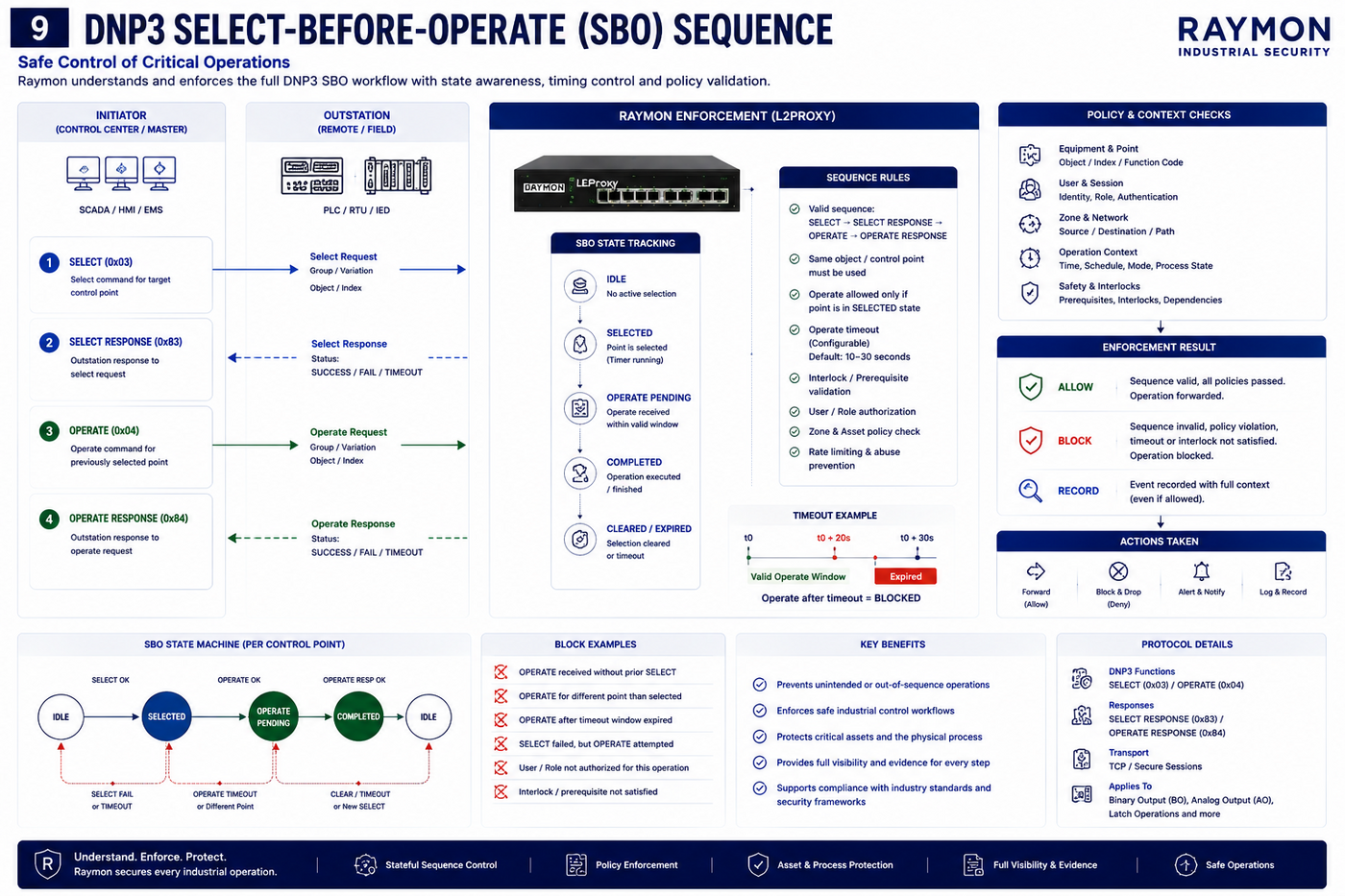
Figure — DNP3 Select-Before-Operate sequence control for grid and substation protection workflows.
Protection beyond a single message
Stateful policies can verify:
- Select followed by a matching Operate within the approved time;
- one-time consumption of a control authorization;
- command followed by expected status feedback;
- active versus standby control authority;
- maintenance authorization before a sensitive command;
- restart, recovery, alarm, and reset sequences;
- excessive repetition, chattering, or missing feedback.
Operational evidence
Instead of reporting only protocol numbers, the system can describe events in terms such as F12 breaker Close, TR1 winding-temperature alarm, relay lockout 86, DER-5 intertie operation, or an invalid OLTC request. The original protocol detail remains available for engineering investigation.
Deployment model
Policies can be introduced in passive mode, validated against representative recorded traffic, and then assigned to an inline L2Proxy service after customer approval. Separate services can be used for different feeders, users, substations, or critical functions.