Industrial Service Deployment Examples
These examples show how independent Service Profiles apply to common industrial needs. They focus on operating outcomes rather than implementation parameters.
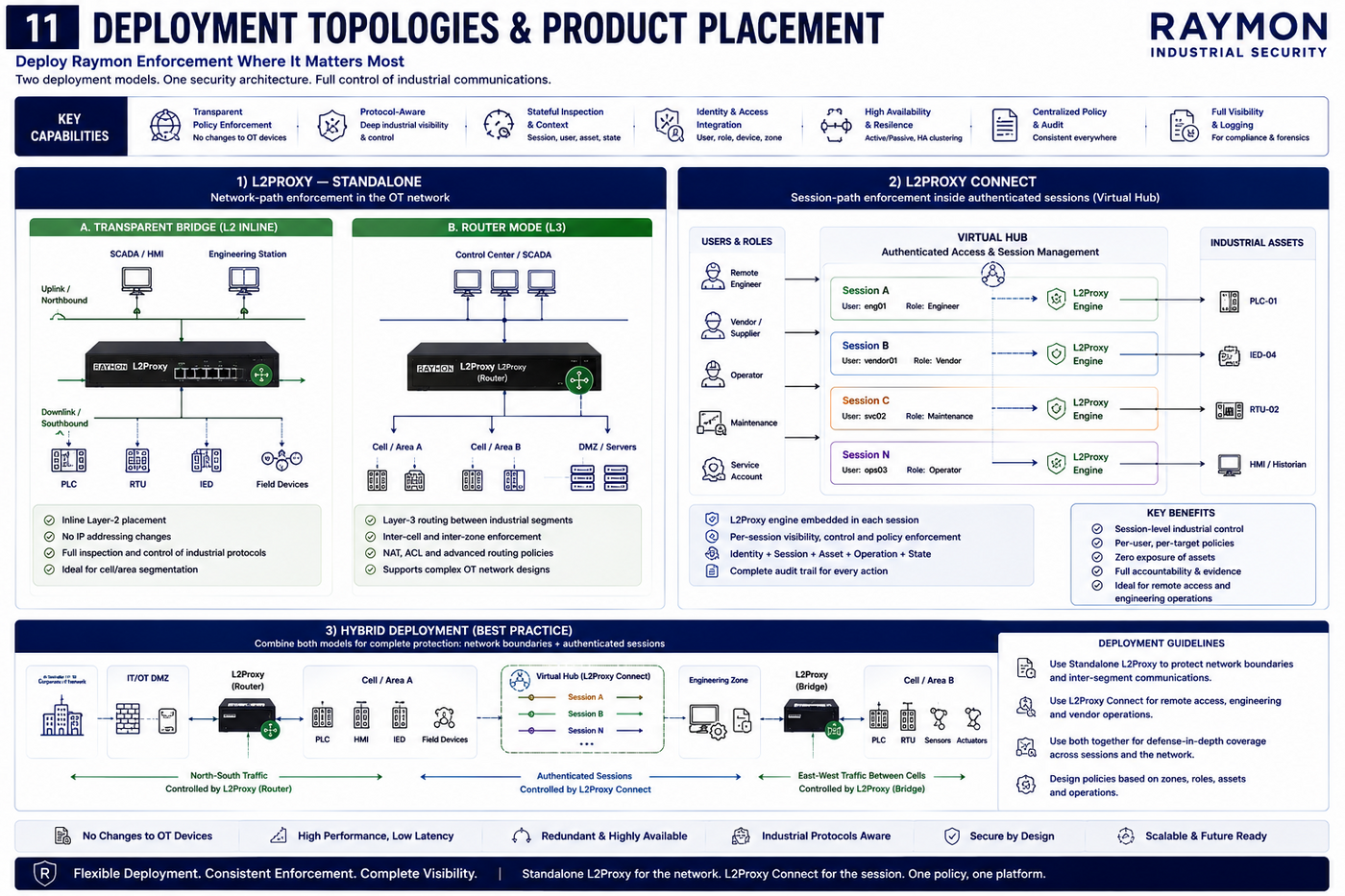
Figure — Industrial deployment examples using Standalone L2Proxy, L2Proxy Connect, and hybrid placement.
Transformer vendor service
| Service element | Applied design |
|---|---|
| Purpose | Time-bounded remote support for TR1 |
| User scope | Assigned transformer vendor VPN user |
| Policy Profile | TR1 measurements plus approved OLTC maintenance operations |
| Protection | Block access to other equipment and reject invalid tap requests |
| Service model | Dedicated inline L2Proxy instance for the user's isolated path |
| Evidence | User-, transformer-, command-, and result-aware events |
The service can be stopped when the maintenance activity ends without changing any other user's protection.
Feeder protection engineering service
| Service element | Applied design |
|---|---|
| Purpose | F12 breaker and relay investigation and approved control |
| User scope | Assigned protection engineer |
| Policy Profile | Read trip, pickup, target, lockout, and breaker state; limited approved controls |
| Protection | Block Close in Local mode or while lockout is active; require approved control sequence |
| Service model | Independent inline enforcement |
| Evidence | Correlated relay state, breaker command, decision, and feedback events |
DER intertie operations service
| Service element | Applied design |
|---|---|
| Purpose | DER-5 monitoring and approved interconnection operation |
| User scope | Assigned DER specialist |
| Policy Profile | Generation measurements and approved intertie Open/Close |
| Protection | Require acceptable voltage and synchronization or dead-bus readiness before Close |
| Service model | Dedicated service isolated from general plant access |
| Evidence | Intertie condition, command, user, and enforcement outcome |
Passive commissioning service
| Service element | Applied design |
|---|---|
| Purpose | Learn behavior of a new production cell without blocking traffic |
| Policy Profile | Expected protocols, equipment, points, and operations |
| Operating posture | Passive observation |
| Protection outcome | Record expected and unexpected behavior for engineering review |
| Transition | Move the approved profile to inline enforcement after acceptance |
This service can operate alongside existing inline services without changing their state or policies.
Offline policy validation service
| Service element | Applied design |
|---|---|
| Purpose | Validate a Policy Profile before a production change |
| Input | Representative recorded industrial traffic |
| Policy Profile | Candidate production profile |
| Outcome | Confirm expected matches, accepted operations, blocked cases, and event metadata |
| Uses | FAT, SAT, regression testing, training, and incident investigation |
Multi-area industrial site
A larger site can operate separate services for:
- remote vendors;
- control-room engineering;
- feeder automation;
- transformer maintenance;
- distributed generation;
- passive asset discovery;
- offline validation and investigation.
Each service has a clear purpose, owner, Policy Profile, lifecycle, and evidence stream. The customer gains centralized management without collapsing distinct industrial risks into one shared enforcement configuration.
Return to Standalone Deployment and Operations.