Guided Rule Authoring
L2Proxy includes a local Rule Authoring Workbench that helps OT engineers move from an operational requirement to a valid protocol-aware expression without memorizing parser abbreviations or helper APIs.
Industrial outcome: create and review precise rules faster, with fewer typing, field-selection, value, ordering, and expression errors before deployment.
This chapter contains the workbench capabilities and representative workflow for offline and printed review. The customer does not need access to a demonstration address to evaluate the authoring experience described here.
More than a text editor
The workbench brings the Rule Engine vocabulary and the l2proxy-dissector field catalog into one guided workflow:
| Authoring capability | Practical value |
|---|---|
| Contextual autocomplete | Suggests functions, protocol layers, fields, operators, values, indexes, and connectors at the current cursor position |
| Protocol-aware filtering | Narrows field suggestions after a protocol layer is selected |
| Searchable field tree | Lets an engineer find a decoded item by industrial name or parser abbreviation and insert it into the expression |
| Typed field access | Shows whether a value is a string, integer, float, Boolean, or repeated field and recommends a compatible accessor |
| Value hints | Presents known function codes, message types, and other enumerated values with readable labels |
| Syntax and context guidance | Shows required preceding fields, valid layers, and parser-derived branch conditions |
| Helper explorer | Documents helper signature, arguments, return type, role, category, example, semantics, and missing-value behavior |
| Metadata guidance | Distinguishes policy predicates from typed accessors intended for structured rule-match evidence |
| Live validation | Combines catalog lint with compilation against the L2Proxy Rule Engine expression environment |
| Industrial rule library | Provides searchable templates and learning paths that can be loaded into the editor and adapted |
The editor uses Monaco—the editing component familiar from VS Code—and is delivered with local assets. Rule content and catalogs do not need to be sent to a public cloud service for authoring or validation.
Parser-aligned discovery
The catalog generator scans the actual l2proxy-dissector source. It records field names, abbreviations, value types, compatible accessors, known values, repeatable fields, layer requirements, ordering hints, and parser contexts. This reduces drift between documentation and the parser version deployed with the product.
The currently generated catalog contains 1,602 fields across 28 protocol layers. It includes full parser-field coverage reported by the generator for DNP3, IEC 60870-5-104, Modbus, S7comm, OPC UA, and other decoded layers. Parser-field availability does not, by itself, imply that every protocol has the same semantic-helper or enforcement maturity; see Capability Status.
Guided expression workflow
An engineer can build a condition incrementally:
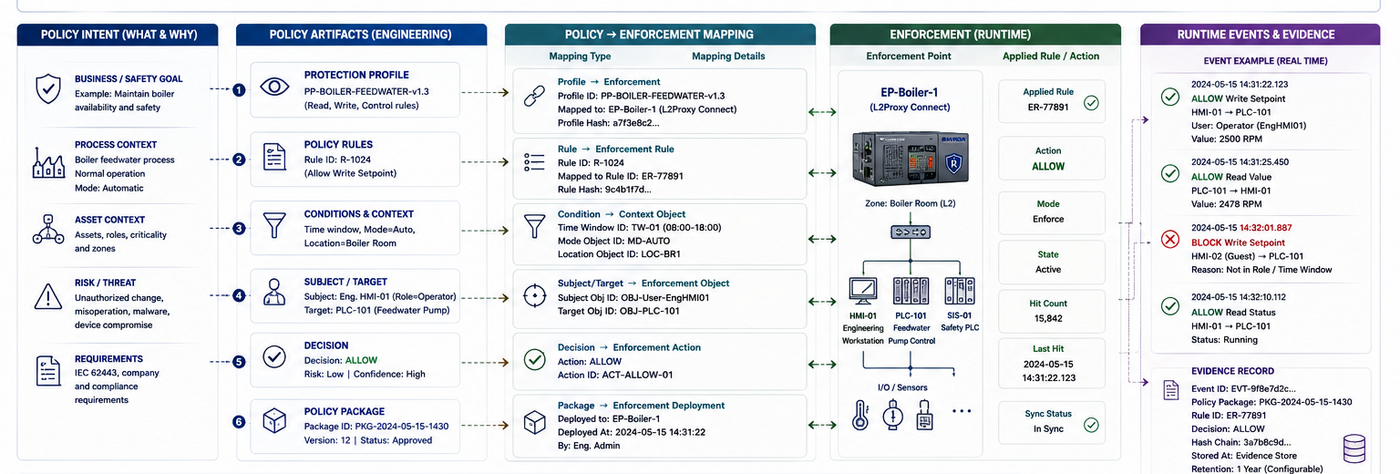
Figure — Guided rule authoring remains traceable from expression to mapped enforcement.
HasLayer("dnp3")
        ↓ choose a DNP3 helper
dnp3.IsRequest()
        ↓ choose the operation and target predicate
dnp3.IsDirectOperate() && dnp3.HasCanonicalEndpoints()
        ↓ compile with the Rule Engine
valid expression
The resulting condition can be placed in a reviewed YAML policy:
- name: review-direct-operate
  order: 20
  condition: >
    dnp3.IsDNP3() && dnp3.IsRequest() &&
    dnp3.IsDirectOperate() && dnp3.HasCanonicalEndpoints()
  action: log
  log: true
  meta:
    policy: '"direct_operate_review"'
    master: 'dnp3.Master()'
    outstation: 'dnp3.Outstation()'
    targets: 'dnp3.ControlTargetCount()'
meta values use the same typed expression environment as conditions. They are
evaluated only for a matching rule when logging is enabled, allowing useful evidence
without adding metadata work to every packet.
Built-in industrial starting points
The current library contains 288 templates organized by protocol, operational topic, and difficulty:
| Protocol | Current templates | Example topics |
|---|---|---|
| DNP3 | 82 | reads, controls, points, quality, files, secure authentication, and advanced objects |
| IEC 60870-5-104 | 55 | ASDU direction, commands, measurements, quality, time tags, and control workflow |
| Modbus | 62 | function codes, reads, writes, addresses, values, exceptions, and transaction behavior |
| S7comm | 89 | session and message structure, read/write operations, blocks, diagnostics, and control-related fields |
Templates are starting points, not site policy. Device roles, addresses, point or
register maps, engineering permissions, process limits, and final accept or drop
decisions remain customer-specific and must be validated with representative traffic.
DNP3 semantic guidance
DNP3 currently provides the deepest helper authoring experience. The workbench exposes more than 200 flat, modular, and metadata-oriented helper entries covering traffic role, function codes, device addresses, objects and points, values, quality, controls, IIN, file transfer, secure authentication, and other protocol details.
For each helper, the engineer can inspect its signature, typed arguments and return
value, industrial meaning, example, request/response semantics, fields read, and
missing-data behavior. This is particularly useful when selecting safe Boolean
predicates for condition and simple-value accessors for meta.
Validation before rollout
The workbench checks complementary classes of error:
- Catalog checks identify unknown abbreviations, incompatible accessors, incomplete syntax, and ordering or context concerns.
- Engine compilation verifies that the expression is accepted by L2Proxy's typed expression environment.
- Traffic validation remains the deployment gate: run the complete YAML rule against representative PCAPs and normal, abnormal, retry, timeout, and malformed cases.
Autocomplete and compile success improve authoring quality; they do not prove that a customer's operational policy is safe. Inline blocking still requires OT ownership, change control, test evidence, and rollback planning.
Why this is a practical differentiator
A protocol-aware engine is most useful when engineers can discover its vocabulary and turn process intent into reviewable policy quickly. By generating knowledge from the deployed parser, explaining helpers in industrial terms, offering reusable examples, and validating expressions locally, L2Proxy shortens the path from decoded traffic to an auditable rule while preserving customer control over the final policy.