Point and Safety Profiles
A point safety profile records what a field value or control means to the process and what the network protection should do when it departs from approved behavior. This keeps operational context with the equipment definition and makes protection reusable.
What a profile carries
| Engineering concern | Profile content |
|---|---|
| Identification | Equipment, point reference, process description, and criticality |
| Measurement quality | Engineering unit, physically permitted range, and nominal value |
| Operating awareness | Normal, alarm, and critical bands or states |
| Control authority | Read-only or controllable status and approved command actions |
| Safe operation | Select-Before-Operate requirement and process prerequisites |
| Response | Record and accept for visibility, or record and stop for enforcement |
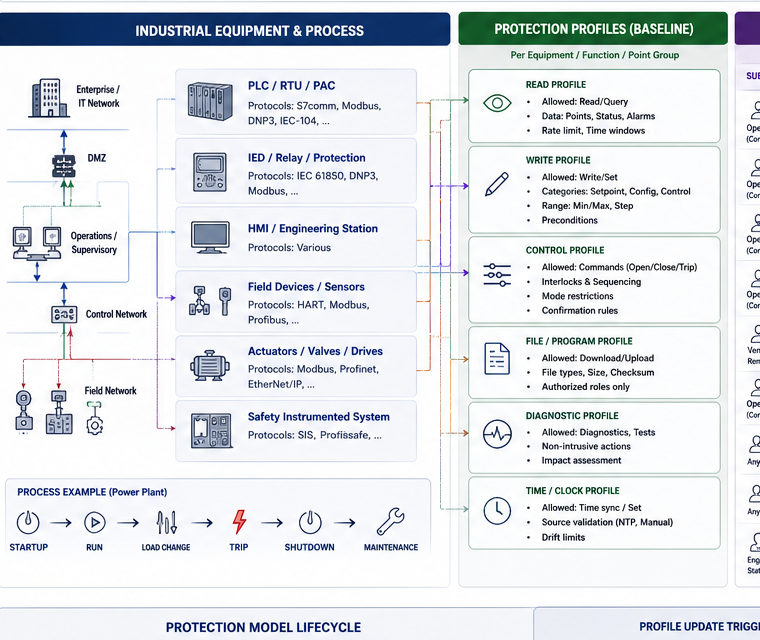
Figure — Point and safety profiles carry the limits, commands, and conditions used in protection.
Four delivered profile patterns cover the current catalog.
Safe analog range
Used for voltage, temperature, loading, power, energy, and position feedback. It can distinguish:
- values inside the expected operating band;
- low or high alarm conditions;
- critical excursions;
- values outside the physically or operationally permitted range.
Worked example — TR1 winding temperature
The delivered profile identifies AI:10 as winding temperature in degrees Celsius. Its permitted measurement range is −20 to 140 °C, nominal value is 65 °C, and the initial high alarm is 95 °C. An event can therefore be presented as a transformer thermal condition—not merely as an unexplained number at a network address.
Permitted binary state
Used for breaker position, Local/Remote mode, trip, pickup, lockout, target, and fault indication. The profile defines recognized states and can identify which state demands an alarm or affects later control decisions.
Worked example — F12 lockout 86
BI:21 identifies whether lockout has operated. Its alarm state is retained as industrial context and can inhibit a related breaker-closing command. This connects protective relay evidence with the switching decision that it should govern.
Permitted switching command
Used for breakers, reclosers, sectionalizers, tie switches, capacitor banks, relay controls, interties, and load shedding. The profile can specify:
- permitted actions such as Open, Close, Pulse, Reset, or Acknowledge;
- whether Select-Before-Operate is mandatory;
- process prerequisites such as Remote mode, no lockout, valid topology, acceptable voltage, or synchronization readiness;
- a blocking response when a control is outside the approved behavior.
Worked example — DER-5 intertie close
Only approved Open or Close actions are recognized. Select-Before-Operate is required. Before a Close can be accepted, bus voltage must be inside the approved band and the synchronization or dead-bus condition must be valid. The control is evaluated as an interconnection operation rather than a generic binary command.
Permitted setpoint range
Used for transformer tap and regulator commands. It defines the permitted setpoint range, sequence requirement, and enforcement response.
Worked example — TR1 OLTC
The requested tap position is constrained to positions 1–17 and requires Select-Before-Operate. Actual position is separately observed on AI:11. This provides the basis for validating both the request and the later feedback behavior.
Monitoring and enforcement
Profiles support two intentional operating postures:
| Posture | Result | Typical adoption stage |
|---|---|---|
| Monitor | Preserve the event and allow traffic to continue | Baseline learning, commissioning, or conditions that require operator judgment |
| Enforce | Preserve the event and stop the non-compliant control | Approved command, sequence, range, or prerequisite protection |
This separation supports a controlled rollout. A customer can validate assumptions against representative operations before enabling enforcement, without rebuilding the equipment model.
Relationship to protection rules
The safety profile is the engineering definition; the linked protection is the operational decision. A single profile may lead to several useful protections—for example, high alarm, critical-high escalation, and outside-permitted-range detection for one measurement. This is why the delivered 36 point profiles support 66 baseline equipment protections.
Customer review checklist
- Confirm that each point description matches the approved field-device map.
- Confirm engineering units, scaling, normal values, and physically valid limits.
- Confirm alarm and critical thresholds against customer standards.
- Confirm which commands are permitted and which points are read-only.
- Confirm Select-Before-Operate and all process prerequisites.
- Confirm monitoring or enforcement posture for commissioning and production.
- Record engineering approval and the effective library version.
Next: Protection Use Cases.